
Creating capacity for prevention in counter fraud
Public sector counter fraud teams face a familiar challenge.
Demand continues to grow. Referrals increase. Expectations around governance, assurance and reporting continue to rise. Yet resources rarely expand at the same pace. When caseloads increase and backlogs begin to emerge, the instinctive response is often to ask whether more investigators are needed.
Additional resource can sometimes help. But the highest-performing counter fraud teams know that sustainable capacity comes from more than increasing headcount.
Instead, they focus on understanding demand and fraud risk, prioritising resources, reducing administrative burden and using intelligence and investigations to prevent future fraud from occurring in the first place.
As Laura Eshelby, Head of Economic Crime at Clue, explains:
“Most counter fraud teams aren’t short of commitment or expertise. The challenge is ensuring limited resources are focused on the activities that create the greatest value. Creating capacity isn’t just about doing more investigations. It’s about improving your ability to prevent future losses and protect public services.”
Capacity matters more than caseload
Caseload figures only tell part of the story. Two organisations might have a similar number of active investigations, but very different levels of risk, complexity and resource pressure.
The more important question is not:
How many cases do we have?
It is:
Are we focusing our limited resource on the work that creates the greatest organisational impact?
For public sector organisations, success is rarely measured by investigative activity alone. Counter fraud teams are increasingly expected to:
- Protect public funds
- Reduce financial losses
- Improve organisational resilience
- Strengthen governance and assurance
- Support better operational decision-making
- Safeguard public services
The challenge is ensuring scarce investigative resource is directed towards these outcomes.
Capacity drain #1: Poor prioritisation
Not every referral carries the same level of risk. Not every investigation delivers the same organisational value. Yet many teams continue to manage demand reactively, addressing work in order of arrival or responding to whichever issues appear most urgent at the time.
The most mature teams take a different approach. They prioritise based on:
- Risk
- Potential harm
- Financial exposure
- Organisational impact
- Opportunities for prevention
- Possible underreporting or unseen losses
This enables them to focus their efforts where intervention is most likely to deliver value.
Laura notes:
“Mature teams don’t just look at what information is coming in. They look at what is not – and use data, analytics and intelligence insights to detect loss and improve underreporting.”
Capacity drain #2: Lack of visibility
Many managers can answer a basic question: How many investigations are currently open?
Far fewer can confidently answer:
- Which investigations are stalled?
- Which workstreams consume the most resource?
- Which teams are under the greatest pressure?
- What types of referrals are increasing?
- Where are the emerging risks?
- Where are reporting blind spots?
Without visibility, capacity management becomes reactive. High-performing teams invest time in understanding both demand and workload. They seek visibility not only of investigations, but also of the factors creating demand in the first place.
This allows them to identify bottlenecks earlier, allocate resources more effectively and make more informed operational decisions.
Capacity drain #3: Administrative burden
Counter fraud professionals are highly skilled. Yet significant portions of their time can still be consumed by administrative activity.
Common challenges include:
- Managing information across multiple systems
- Updating spreadsheets and trackers
- Manually producing reports
- Re-entering information
- Chasing updates and approvals
- Searching for relevant information
Each of these activities consumes capacity that could otherwise be directed towards intelligence development, investigations or preventative work.
Organisations such as Companies House have highlighted how moving away from spreadsheet-heavy processes has enabled a greater focus on strategic intelligence and risk-based decision-making. The NHS Counter Fraud Authority has similarly demonstrated the value of creating visibility across investigations, proactive activity and outcomes at scale.
The objective is not simply greater efficiency. It is ensuring more time is spent on work that actively protects public funds and strengthens organisational resilience.
Capacity drain #4: Repeat demand
Perhaps the greatest constraint on capacity is one that often goes unnoticed.
Many investigations reveal:
- Repeated fraud typologies
- Recurring process weaknesses
- Control gaps
- Organisational vulnerabilities
- Common patterns of behaviour
If this learning is not captured and acted upon, the same issues continue to generate future demand. This creates a cycle where teams repeatedly investigate the consequences of problems rather than addressing their root causes.
The most mature counter fraud functions break this cycle. They treat every investigation as an opportunity to learn, improve and reduce future risk. Each investigation represents an opportunity to understand not only what happened, but why it happened. The organisations creating the most sustainable capacity use investigation outcomes to strengthen controls, close vulnerabilities and reduce the likelihood of similar losses occurring again.
As Laura explains:
“The organisations creating the most sustainable capacity aren’t necessarily conducting fewer investigations. They’re using investigations more effectively. Every case should increase understanding, inform prevention activity and reduce the likelihood of the same issue occurring again.”
Measuring more than activity
Most counter fraud teams already track operational activity:
- Referrals received
- Investigations opened
- Investigations completed
- Case outcomes
These measures remain important. However, mature teams increasingly seek to understand more than activity levels alone. They combine operational measures with information about detected losses, recoveries, estimated exposure, organisational risk and prevention outcomes to build a clearer picture of impact.
Questions worth considering include:
- Are repeat issues reducing over time?
- Are controls still effective?
- Are we directing resources towards the highest-risk areas?
- Are preventative interventions reducing future demand?
Although possible, prevention can be difficult to quantify, and no organisation has a perfect measure of prevented fraud. However, mature teams recognise that understanding trends, learning from investigations and identifying reductions in repeat demand can provide valuable indicators of preventative impact.
We explore approaches to measuring preventative outcomes and organisational impact in more detail in a future article.
From capacity to impact
The most effective counter fraud teams do not create sustainable capacity simply by working harder.
They create sustainable capacity by:
- Prioritising risk more effectively
- Improving visibility of demand and workload
- Reducing unnecessary administrative burden
- Learning from investigations
- Preventing future demand wherever possible
In doing so, they maximise the value of every hour spent protecting public funds and supporting public services. Ultimately, the objective is not fewer investigations. It is greater impact from the same resource.
What next?
If your organisation is experiencing growing demand, increasing caseloads or pressure on resources, the first step is understanding where your current approach sits today.
Creating capacity is not simply about investigating more cases. It is about creating the time and insight needed to understand risk, improve controls and prevent future losses.
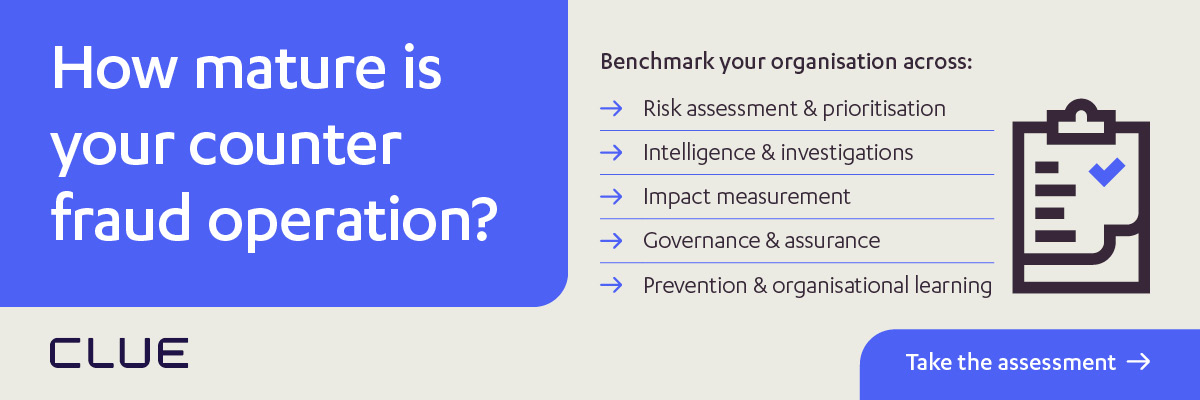
Our Public Sector Counter Fraud Maturity Assessment helps organisations benchmark their approach across:
- Triage and prioritisation
- Investigation management
- Intelligence and information management
- Capacity and productivity
- Governance and assurance
- Prevention and organisational learning
Or, if you would like to discuss the challenges facing your organisation in more detail, arrange a Counter Fraud Maturity Review with Laura Eshelby, Head of Economic Crime at Clue.
Together, you’ll explore where resource is currently being consumed, where opportunities for improvement exist, and how your organisation can create greater capacity for prevention.
Related Resources

Beyond the Five Eyes: what global fraud landscapes can teach us
New research presented at ISEC 2026 reveals how fraud evolves alongside economic and technological development, offering valuable lessons for practitioners t...
Learn more
Introducing our SOAC Threat Assessment 2026
In our Serious and Organised Acquisitive Crime (SOAC) Threat Assessment 2026, we explore how low‑level loss and repeat incidents often form part of wider org...
Learn more
Economic crime is evolving - our collective response must too
Insights from Clue’s latest Threat Insight Group on emerging threats, system-wide challenges, and responses to economic crime.
Learn more