
Economic crime is evolving – our collective response must too

At our latest Threat Insight Group session, we brought together members of the Clue community alongside guest speakers from HMRC and the City of London Police to explore how the economic crime landscape is changing.
The discussion made one thing clear: economic crime is not just growing – it’s becoming more complex, more connected, and more difficult to detect.
A threat that continues to expand
Economic crime spans a wide range of activity, from fraud and money laundering to corruption and illicit finance – all designed to generate profit through deception or by exploiting systems.
Across the UK, the scale of the challenge continues to increase. Fraud alone now represents a significant proportion of crime experienced by individuals and businesses, with criminals continually adapting their methods.
But the most significant shift is not just in volume – it’s in how these crimes are carried out.
More sophisticated, more connected
Insights shared during the session highlighted how economic crime is increasingly shaped by:
- Technology – with digital platforms, AI, and alternative payment systems enabling fraud at scale
- Global networks – with organised groups operating across jurisdictions and targeting victims internationally
- Complex financial pathways – used to obscure the movement of money and reduce traceability
Together, these factors mean that economic crime is no longer a series of isolated incidents. It operates across systems, networks, and borders – often requiring coordinated responses to fully understand and act on it.
A system under pressure
Speakers from HMRC and City of London Police shared how these changes are creating real challenges across the system.
Data remains fragmented across organisations. Reporting mechanisms don’t always provide a complete picture. And in many cases, action still happens after harm has already occurred.
At the same time, the speed at which criminals can operate – particularly using digital tools – is increasing the gap between threat and response.
The need for a different approach
A consistent theme throughout the session was the need to move beyond reactive models.
Instead, organisations are looking to:
- Identify threats earlier
- Understand patterns and behaviours, not just individual incidents
- Connect intelligence across teams, organisations, and sectors
- Work more closely with partners to coordinate disruption efforts
There is growing recognition that no single organisation has a complete view of economic crime – and that effective response depends on shared insight and collaboration.
Supporting a more proactive response
At Clue, we’re working with organisations across the public and private sector to support this shift.
By bringing together intelligence, data, and investigations in one environment, teams can better identify patterns, connect activity, and act earlier to prevent harm.
As the discussion at our latest Threat Insight Group highlighted, economic crime will continue to evolve. Strengthening our collective response – through better intelligence, earlier detection, and closer collaboration – will be key to staying ahead of it.
Contact our Head of Economic Crime, Laura Eshelby, to discuss any points raised in the Threat Insight Group and learn more about how Clue can help with these challenges.
Related Resources

Beyond the Five Eyes: what global fraud landscapes can teach us
New research presented at ISEC 2026 reveals how fraud evolves alongside economic and technological development, offering valuable lessons for practitioners t...
Learn more
Introducing our SOAC Threat Assessment 2026
In our Serious and Organised Acquisitive Crime (SOAC) Threat Assessment 2026, we explore how low‑level loss and repeat incidents often form part of wider org...
Learn more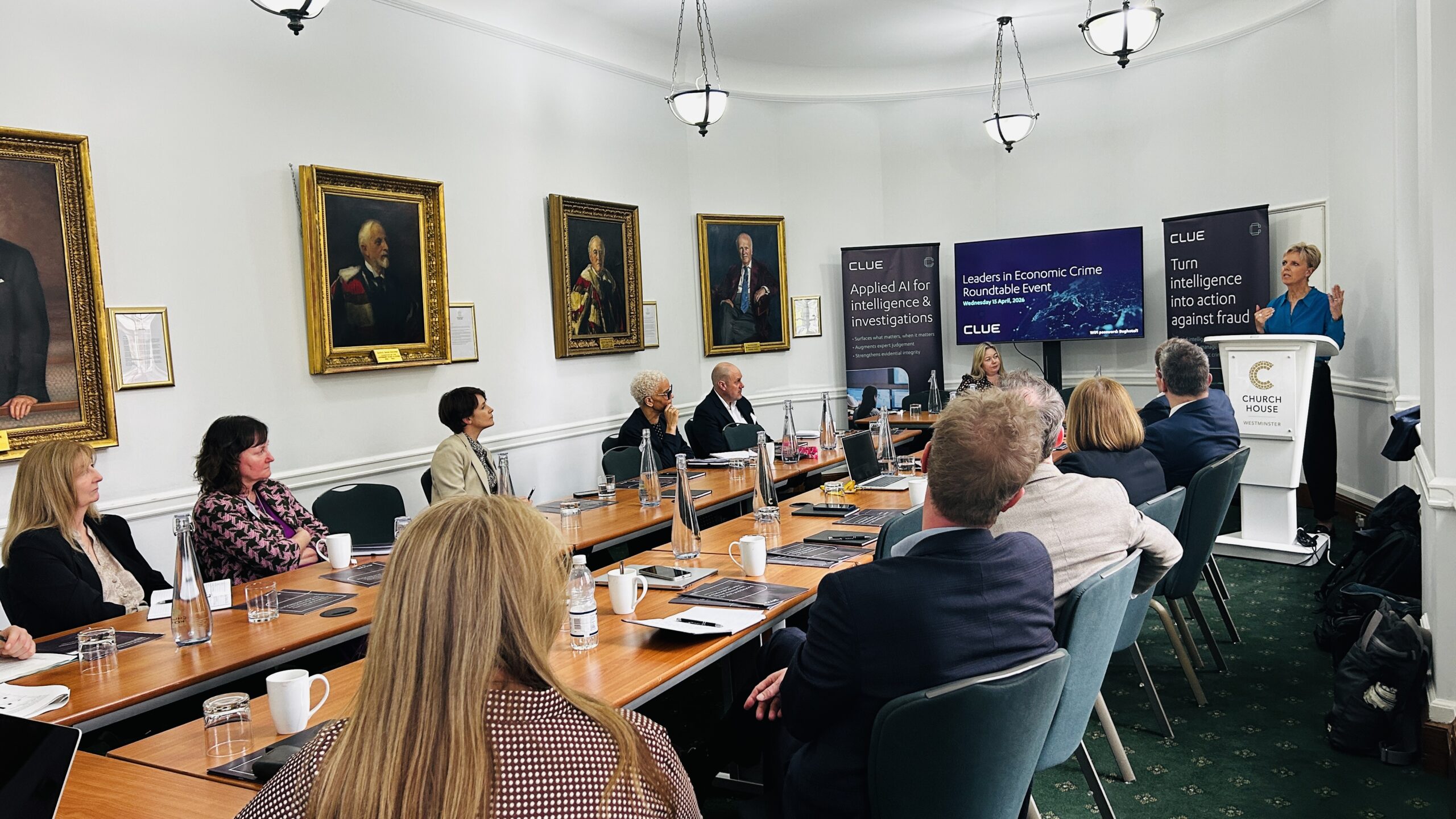
Economic crime in 2026: What leaders are seeing and why it matters
The roundtable event highlighted a clear consensus: economic crime is now a systemic, technology‑enabled threat that cannot be addressed through reactive inv...
Learn more