Nine converging threats shaping corporate security in 2026
Corporate security risk has entered a new phase. Digital, physical, criminal, regulatory and reputational threats increasingly converge, often through people, identity and suppliers rather than obvious system failures. In this environment, weak signals can escalate quickly, and issues that look isolated on paper rarely stay that way in practice.
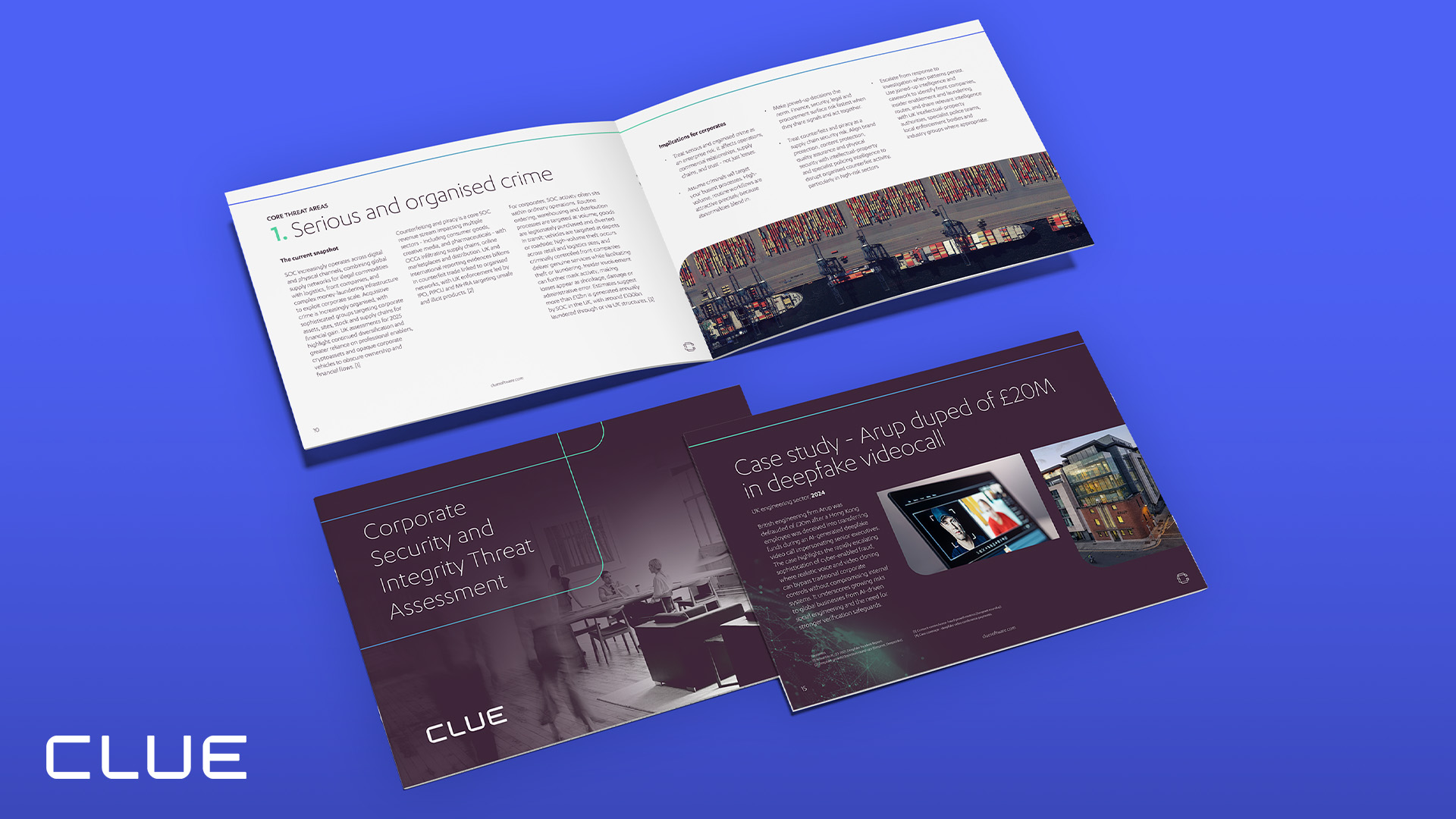
Clue Software’s Corporate Security and Integrity Threat Assessment 2026 sets out nine threat areas we see as most significant for large corporates today. Drawing on open‑source and official reporting, regulatory and law enforcement insight, and frontline investigative experience, the assessment focuses on how these threats actually manifest inside everyday business processes.
Below is a high‑level overview of the nine converging threats shaping corporate exposure in 2026.
1. Serious and organised crime
Organised criminal groups increasingly exploit corporate scale, using logistics, supply chains, front companies and routine workflows to hide theft, diversion, counterfeiting and illicit finance in plain sight. Loss often appears as shrinkage, error or damage rather than crime.
2. Fraud
Fraud is moving from “breaking in” to “talking its way in”. AI‑enabled impersonation and synthetic media allow criminals to convincingly pose as executives, suppliers or customers inside normal business interactions, turning everyday approvals and verification steps into attack paths.
3. Terrorism and extremism
The most credible risk remains lone‑actor, low‑sophistication attacks against publicly accessible places. The emphasis for organisations is increasingly on preparedness, clear first‑five‑minutes routines and proportionate protective measures, rather than prediction alone.
4. Cyber crime and information security
Cyber incidents are now dominated by identity abuse, supplier access and quiet footholds on edge devices. Data‑extortion models compress response timelines, raising the stakes for fast, well‑evidenced decision‑making during incidents.
5. Insider threat
Most insider harm is not overtly malicious. Negligent, compromised or coerced insiders are common, particularly across hybrid workforces and contractor networks. State‑linked actors also increasingly seek to manufacture insiders through recruitment and advisory routes.
6. Corporate espionage and hostile state activity
Espionage is typically patient and people‑focused. Access is cultivated through CVs, expert engagements, partnerships and advisory work, exposing sensitive information long before any obvious compromise is visible.
7. Sanctions risk and geopolitical exposure
UK sanctions enforcement has tightened, with rising expectations for event‑driven due diligence and auditable decision‑making. Even routine payments or services can carry serious exposure where value ultimately flows to a designated party.
8. Protest, activism and physical security
Campaigns mobilise quickly online and can translate into on‑site disruption with little warning. Risk increases where early indicators are fragmented, informal or not escalated beyond frontline teams.
9. Safeguarding and exploitation
Modern slavery, labour exploitation and abuse of trust persist deep within supply chains and operations. Stakeholders increasingly expect evidenced action and remedy, not just policy statements.
Why this assessment matters
Across all nine areas, the common thread is convergence. Organisations that perform best bring signals together early, assess risk in context, and escalate to investigation when patterns persist. The Corporate Security and Integrity Threat Assessment 2026 explores these threats in depth, with practical implications and real‑world case studies to support more confident, intelligence‑led decision‑making.
Access the full report to explore each threat in detail and understand what intelligence‑led resilience looks like in practice for large corporates navigating an increasingly complex threat landscape.
Related Resources

Clue at Govnet Counter Fraud Conference 2026
Technology underpins fraud today. Counter Fraud Conference 2026 was a chance to spotlight the most pressing threats, while championing the methods, teams and...
Learn more
New report: Tackling Fraud in the Public Sector in 2026
As fraud continues to account for a growing proportion of crime, public sector organisations face an increasingly complex challenge in preventing, detecting ...
Learn more
Clue launches Economic Crime Threat Assessment 2025
Fraud and economic crime are escalating into a national resilience challenge. Clue’s new threat assessment sets out the scale of the problem - and how organi...
Learn more

What's behind the rising insider risk and why does traditional security no longer suffice? Our latest Threat Assessment outlines an intelligence-led approach to detection and prevention, from national security breaches to ransomware.