
Companies House
Companies House adopted a range of tools, including Clue, to support its intelligence and enforcement transformation and its mission to drive corporate transparency and economic growth.
Companies House, an executive agency of the UK Department for Business and Trade, plays a critical role in maintaining the integrity of the UK’s corporate register. Its mission is to support corporate transparency and economic growth by granting limited liability and providing data that underpins credit and business decisions, strengthening confidence in the UK economy.
In recent years, growing abuse of UK corporate structures for illicit purposes – such as money laundering, phoenixism, and fraudulent company formations – prompted the most significant reform in 180 years: the Economic Crime and Corporate Transparency Act (2023). This legislation transformed Companies House from a passive registry into an active gatekeeper of company creation and custodian of reliable data.
Challenge
Before reform, Companies House faced major limitations:
- Passive role: Required to accept information if forms were completed correctly, even if suspicious.
- Limited enforcement powers: Had limited powers to reject or remove inaccurate or misleading data.
- Limited intelligence sharing abilities: Lack of proactive data sharing powers with other organisations.
- Data overload: Holding significant volumes of data on directors and companies.
- Economic crime threats: Corporate structures exploited for fraud, money laundering.
The scale of abuse demanded a risk-based, intelligence-led approach supported by modern technology.
Solution
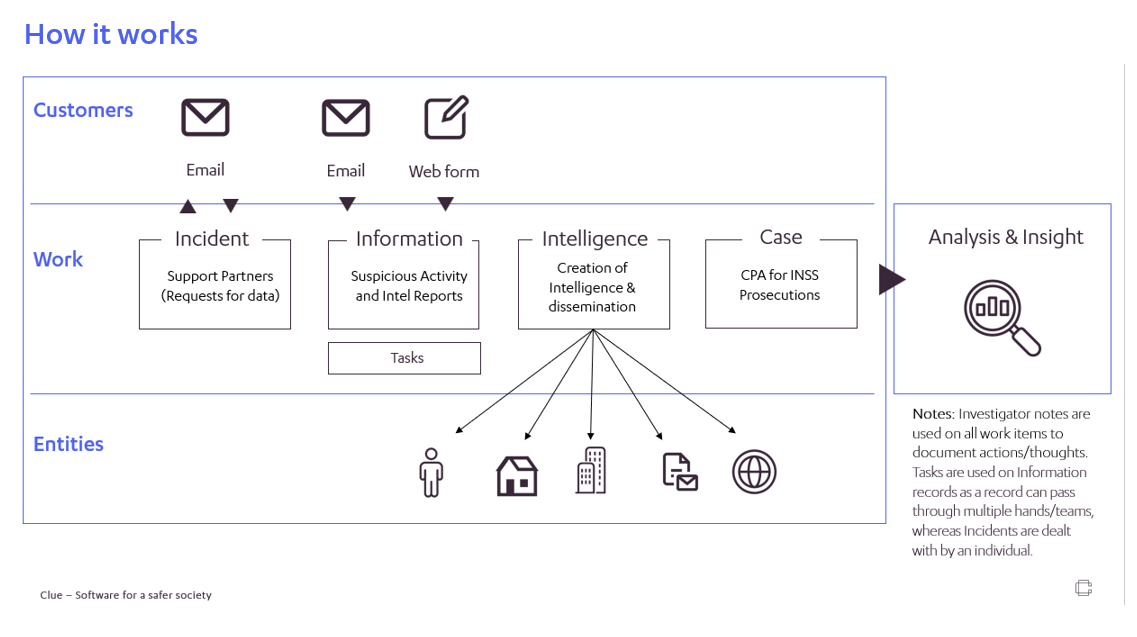
Companies House adopted a range of tools, including Clue, to support its intelligence and enforcement transformation:
- Agility and flexibility: Clue adapted to evolving workstreams and new legislative powers
- Risk-based decision making: Companies House staff use the software to support risk-based compliance processes, including prioritising companies for targeted action.
- Integrated workflows: Web forms streamlined intelligence sharing; CPIA-compliant registers supported legal processes.
- Data-driven insight: Clue provided a single searchable view, replacing spreadsheet-heavy processes and enabling network analysis.
- Partnership enablement: Facilitated secure data sharing with law enforcement and insolvency services.
Impact
The combination of new legislative powers (March 2024), a tenfold increase in intelligence staff, improved processes, and modern technology tools has enabled Companies House to deliver significant results.
The flexibility of tools like Clue has supported the organisation’s transformation from spreadsheet-based processes to focusing more on strategic intelligence capabilities.
Companies House has also seen multi-agency enforcement success including the crackdown on fraudulent cloning where 786 fake companies were disrupted; 2,895 appointments were removed; 965 companies were struck off, and 929 names were forcibly changed. These results reflect Companies House’s cultural shift from a passive registry to a proactive gatekeeper, safeguarding the UK economy.
Companies House is fundamentally changing its role, focusing on becoming the trusted guardian of corporate transparency by creating an environment where legitimate businesses can thrive whilst making it significantly harder for criminals to exploit our system. Clue is one of the tools Companies House has used to support this work, alongside new powers, expanding teams and strengthened partnerships.
This case study does not constitute an endorsement by Companies House of Clue or its products

What's behind the rising insider risk and why does traditional security no longer suffice? Our latest Threat Assessment outlines an intelligence-led approach to detection and prevention, from national security breaches to ransomware.